AI UGC for beauty and skincare: how to create influencer videos that sell cosmetics
A complete guide to using AI UGC videos in beauty: scripts, scene setup, strategy by sub-niche and creative scaling for cosmetics.
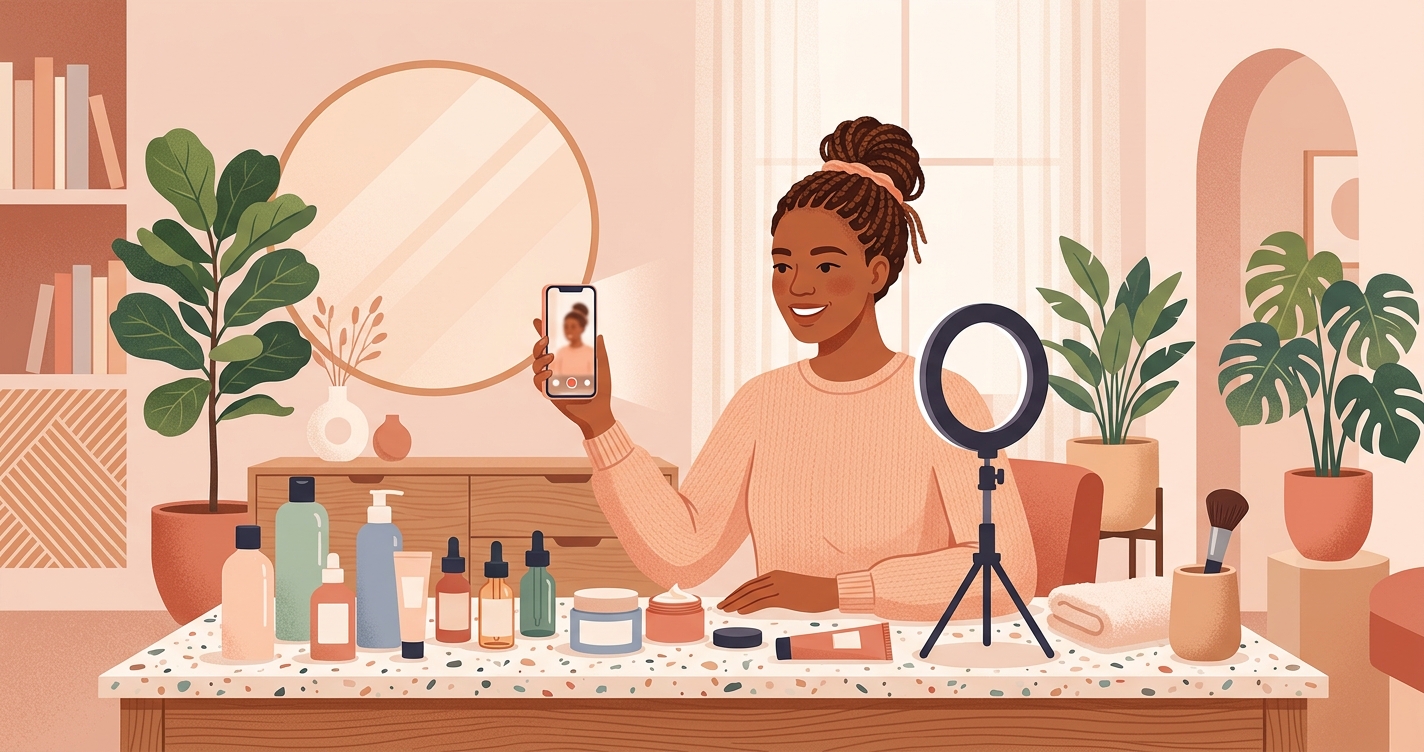
The beauty sector is one of the most competitive on TikTok and Instagram: dozens of brands fight over the same 2 to 3 seconds of attention in the feed of a consumer who usually already knows the problem they want to solve but has not yet chosen the product. In this context, the format that converts best is not the corporate ad with flawless production, it is the UGC influencer video presenting the product in use, with a personal-recommendation tone.
With AI UGC tools like AvataReel, beauty brands and resellers can create these creatives at scale, with no model, no studio and no agency cost. This guide shows how to structure scripts, build scenes and scale variations for cosmetics, skincare and hair products.
Why the UGC format works especially well for beauty
In beauty, the purchase decision depends on two factors that UGC solves better than any other format:
Seeing the result. Buyers want to see the product in use before buying, what it does to their skin, hair or nails. Static ads show the packaging; influencer UGC shows the application, the texture, the absorption and, when possible, the result.
Trust through identification. People who buy skincare, makeup or hair products do not want a lab ad, they want to see someone with the same skin type, a similar skin tone or similar hair saying the product worked. The UGC format simulates exactly this personal recommendation.
The 3 beauty sub-niches and their particularities in video
Beauty is not a uniform market. Skincare, makeup and haircare have distinct buying dynamics and script angles.
Skincare (moisturizers, serums, sunscreen, face oils)
Skincare is the sub-niche with the biggest routine and consistency component. Buyers want to know: does this product fit my routine? Will it work on my skin type?
The script angle that works best: an everyday problem solved. Dry skin in winter, oiliness in the heat, spots that will not go away, uneven texture are problems consumers recognize instantly. The influencer describes the problem in the first person and presents the product as the solution they have already tested.
Ideal length: 15 to 30s, with the product in the scene (bottle on the counter, being applied with the fingertips).
Makeup (foundations, concealers, lipsticks, highlighters)
Makeup has high creative turnover because the trend cycle is short. Buyers decide quickly, the price tends to be lower and the impulse is visual.
The angle that works: an immediate result. "I put on this highlighter and the finish looks like this" is more direct than any technical argument. The influencer shows the product in use with a short sentence describing the effect.
Ideal length: 8 to 15s, with a visual hook in the first 2 seconds.
Haircare (shampoos, conditioners, hair oils, styling products)
Haircare has a specific challenge: the result takes longer to appear and is hard to show in a short video. What converts are comparison scripts ("I used to use X, now I use this") and routine testimonials.
The angle that works: a routine before and after, focused on the feel (softness, shine, curl definition) and ease of use.
Ideal length: 20 to 35s, with the product built into a care sequence.
Script structure for each sub-niche
Script type 1: everyday problem (skincare)
"My skin gets way too dry in winter, I feel the tightness in the first hour of the morning. I started using this hydrating serum at night and in less than a week the difference was already visible. The bottle lasts a long time because you use very little per application. I found it through the link in the bio."
Structure: problem (dryness) → product (serum) → tangible result (difference in one week) → practical detail (value of the bottle) → CTA (link in bio).
Script type 2: immediate result (makeup)
"This highlighter is different from anything I've used. It doesn't leave that overly shiny look, it's a natural glow that lasts all day. I put it on my cheekbones and temples and it came out like this. Worth every penny."
Structure: differentiating hook → visual result → technical detail → value-for-money validation.
Script type 3: routine comparison (haircare)
"I used to spend a fortune on conditioners that did nothing for my curly hair. I replaced everything with this hair oil and use it twice a week as a leave-in. My hair got softer, with more defined curls, and the frizz is gone. The price is very reasonable for the result it delivers."
Structure: previous situation → product → frequency of use → specific results → value for money.
| Skincare | Makeup | Haircare | |
|---|---|---|---|
| Ideal video length | 15 to 30s | 8 to 15s | 20 to 35s |
| Main angle | Everyday problem solved | Immediate visual result | Routine comparison |
| Scene element | Bottle on the counter, application | Application on the face | Hair before/after use |
| Dominant purchase trigger | Trust and consistency | Impulse and trend | Transformation and convenience |
| Renewal frequency | Every 3 to 4 weeks | Every 1 to 2 weeks | Every 2 to 3 weeks |
| Best funnel stage | Top and middle | Top (quick conversion) | Middle and bottom |
How to build the scene in AvataReel for beauty products
AvataReel lets you include a product image and a scene description. For cosmetics, this field is especially important because consumers expect to see the product in context, not just the influencer talking to the camera.
A few scene description examples for beauty:
Skincare: "Bathroom counter with natural light. Influencer holds a white serum bottle with a gold cap. Clean skin, no makeup."
Makeup: "Setting with good makeup lighting. Influencer applies highlighter to the face with a brush. Product featured next to the mirror."
Haircare: "Damp hair after a shower. Influencer applies hair oil with their hands. Hair texture visible to the camera."
The product image you include in AvataReel is used to compose the scene visually. Use a photo of the bottle or packaging with a clean background (white or transparent) for the best result.
Creative strategy by campaign stage
Testing phase (first 7 days)
In this phase, the goal is to find out which angle resonates with the audience before scaling the budget. Generate 3 to 5 variations with different hooks for the same product: one focused on the problem, one on the result and one comparing value for money.
Use different influencers from the catalog to test which face profile has the best CTR with your product's audience. For oily-skin skincare, for example, an influencer with younger features may work better than one with a more mature adult profile.
Scaling phase (after finding the winner)
Once you identify the creative with the best CTR and lowest CPM, generate variations of the winning script: keep the structure, swap the hook, the influencer or the product detail.
For a catalog of 10 cosmetic products, with 3 variations per product, that is 30 creatives. With AvataReel, those 30 videos are ready in under an hour.
Maintenance phase (keeping a creative hot for longer)
Beauty creatives saturate faster than those in other niches because consumers are bombarded with cosmetics videos on TikTok and Reels. The saturation signal is CPM rising without a proportional increase in conversions.
Swap the active creative every 2 to 3 weeks for skincare, and every 1 to 2 weeks for makeup. Keeping at least 3 variations in simultaneous rotation slows down saturation.
Common mistakes in beauty UGC videos
A script that is too technical. Beauty consumers do not want to learn about the INCI list or active ingredient percentages in the ad's hook. They want to know what the product does for their face or hair in everyday language. Save the technical details for the product description on the landing page.
A generic scene with no visible product. An influencer talking to the camera without the product in the scene loses beauty UGC's main advantage: seeing the item in use. Always include the product image in AvataReel and describe the scene with the product featured.
A promise that is too broad. Claims like "this serum fixes all skin problems" trigger consumer skepticism and can violate platform ad policies. Be specific: "more hydrated skin in one week" is more believable than "transformed skin."
A length outside the sub-niche standard. A 45s video trying to sell an impulse lipstick will lose the viewer halfway through. An 8s video trying to explain a skincare routine will leave questions unanswered. Match the length to the product type and the funnel stage.
Practical tips to raise click-through rate in beauty
- In the first 2 seconds: show the product or name the problem precisely. "Dry skin that flakes in winter?" converts more than "Hi, today I'm going to talk about a product I loved."
- On-screen text: reinforce the spoken hook with overlaid text, especially the product name or main benefit. Many users browse with the sound off.
- A CTA with a location: "Link in bio" or "Go to the site" works better than "Buy now" for top-of-funnel creatives, where the consumer is still in discovery mode.
- Seasonality: adapt the script to the time of year. In Brazil's winter (July), the dry skin hook is highly urgent; in November, sunscreen. Use this window of relevance to prepare seasonal creatives ahead of time.
- Skin or hair micro-niche: if your product is specific to a skin type (oily, dry, combination) or hair type (curly, straight, colored), mention it in the script. Specificity increases identification and naturally filters the right audience.
Next steps
The beauty sector is one of those that demand the most creative volume and speed: trends change fast, seasonal campaigns have short windows and saturation arrives sooner than in other niches. AvataReel solves exactly this bottleneck by letting you create influencer videos in Portuguese, English or Spanish, with the product in the scene, in under 2 minutes per video.
With the influencer catalog available, you can test different profiles for the same product, find which converts best with the specific audience in your beauty niche and scale at no extra production cost.
Create your account and generate your first video →
See also: AI UGC for ecommerce: how to create influencer videos that sell physical products and UGC scripts that convert: 5 ready-made structures for 9:16 videos.
Frequently asked questions
Does AI UGC work for selling cosmetics and skincare?
Yes. The beauty sector is one of the best at converting with the UGC format because buyers want to see the product in use before buying. With AvataReel, you create an influencer video presenting the cosmetic in an everyday use scene, with no model, no studio and no agency.
How do I show the cosmetic product in the video generated in AvataReel?
In AvataReel, you include the product image along with the scene description. The influencer appears in context with the product: holding the bottle, applying it, or at a skincare counter. You describe the scene with the product in the script and include the photo of the bottle or packaging.
Which UGC video length works best for cosmetics on TikTok and Reels?
For lower-priced beauty products (below R$80, in Brazil), videos of 8 to 15s with a strong visual hook convert well at the top of the funnel. For premium or long-use cosmetics (such as skincare items tied to a routine), 21 to 45s lets you explain the routine, show the product in use and include a full CTA.
Can I create UGC videos for a beauty product catalog without needing a human model?
Yes. AvataReel uses a catalog of ready-to-use digital influencers, with no need to hire a model or photographer. For each product in the catalog, you create a different video with the same influencer or switch between profiles to reach different audiences.
Does AvataReel support scripts with beauty terms?
Yes. AvataReel's TTS and lip sync work in Portuguese, English and Spanish and handle beauty-sector terms such as 'moisturizer', 'serum', 'sunscreen', 'highlighter' and 'face oil' without an accent or intonation that sounds artificial.
How many creative variations should I generate per cosmetic product to test in ads?
The recommended minimum is 3 variations per product: one with a problem hook (dry skin, dark spots, oiliness), one with a result hook (hydration, evenness, glow) and one with a cost comparison (what it costs to keep up a full routine vs. one product that does it all). This covers the main purchase motivations before you scale the budget.
Upload a photo, record your voice and type the script. Your first avatar is free.
Create my free avatar →