AI UGC for ecommerce: how to create influencer videos that sell physical products
A complete guide to using AI-generated UGC videos in ecommerce: catalog strategy, scripts that convert and creative scaling.
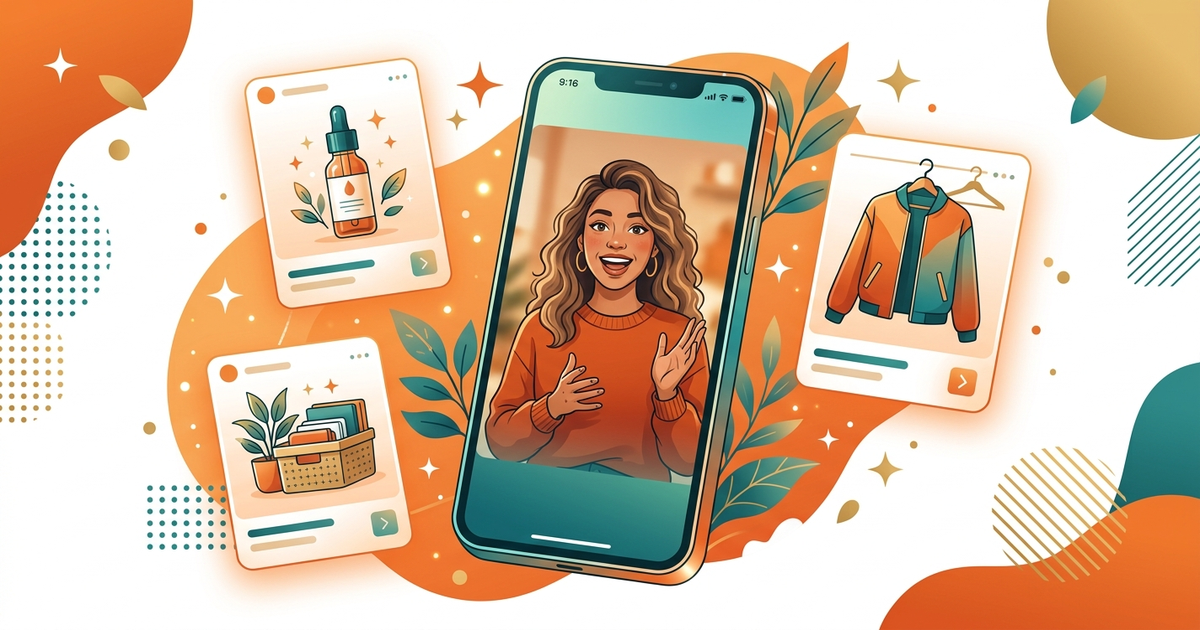
Online stores face a production problem that grows with the catalog: every product needs creatives, every creative needs to be tested in variations, and the cost of traditional production makes it unviable to cover more than a few items a month. The result is that most campaigns run the same 3 to 5 creatives for weeks on end, performance drops from saturation and the traffic manager runs out of material to test.
AI UGC solves this bottleneck directly: you create one influencer video per product, in under 2 minutes, at a cost that lets you cover the whole catalog and still have variations for A/B testing.
Why UGC outperforms other creative formats in ecommerce
Ecommerce stores have three classic types of creative: a product photo on a white background, a brand video with a soundtrack and UGC. Over the last two years, performance data on Meta Ads and TikTok Ads shows a growing gap between them in cost per click and conversion rate.
The explanation is not technical, it is behavioral: users scrolling the feed have learned to ignore creatives that look like ads. A product photo on a white background is instantly recognized as advertising. UGC, especially in vertical format with an influencer speaking straight to the camera, blends organically into the feed's content, and that makes a difference in the first 2 to 3 seconds of exposure.
The second reason is implicit social proof: when an influencer recommends a product in the first person, viewers process it as a recommendation, not as an ad. This effect is well documented in consumer psychology and is the basis of UGC's success as a performance format.
The 3 UGC formats that convert best for physical products
1. Direct problem and solution
The influencer opens by naming an everyday problem the product solves. No introduction, no corporate context, straight to the point. It is the best-performing format at the top of the funnel for audiences that do not know the product yet.
"My bag was a mess and I spent minutes looking for my keys every morning. This organizer changed that completely. Everything in its place, access in seconds. It's in the link in the bio."
2. Visual or experience result
The influencer describes the result the product delivered, in sensory or practical terms. It works well for beauty, cleaning, organization and cooking products, where the result is noticeable and easy to put into words.
"I tested the serum for two weeks and my skin looked visibly more even, especially the little spots I'd had for years. I had never invested in skincare like this, but it was totally worth it. Go to the link."
3. Implicit comparison
The influencer compares the product with the more expensive, laborious or less effective alternative, without naming competing brands. It converts well in the middle of the funnel for users who have already researched the product and are weighing value for money.
"I used to spend a fortune at the salon every time I wanted to straighten my hair. This heat protectant at home gives the same result, lasts weeks and costs far less than a visit. I've already recommended it to my mom and my sister."
How to write scripts for physical products
The most common mistake in ecommerce UGC scripts is starting by describing the product instead of starting with the buyer. The algorithm does not cut the video because of the product, it cuts it because the camera stopped being interesting to the user. What keeps the user watching is the first 3 seconds, and those 3 seconds need to be about them, not about the product.
The structure that works best for physical products has four parts:
- Hook (0 to 3s): names the problem or the result, without mentioning the product yet
- Brief context (3 to 8s): one sentence that sets the everyday situation and creates identification
- Solution (8 to 20s): presents the product as the answer, with one specific benefit
- CTA (last 3 to 5s): invites the click, simple and direct
| Product-focused script | Buyer-focused script | |
|---|---|---|
| Opening | 'This organizer has 12 compartments...' | 'My drawer was chaos until I found this' |
| Main focus | Features and specifications | Problem solved, result obtained |
| Tone | Corporate, looks like an ad | Personal, looks like a recommendation |
| Retention in the first 3 seconds | Low | High |
| Conversion on cold audiences | Lower | Higher |
| Ideal use | Remarketing (already knows it) | Top of funnel (new audience) |
Catalog coverage strategy with AI UGC
One of the biggest advantages of AI UGC for ecommerce is coverage at scale. With traditional production, covering 20 products with 3 variations each would mean 60 videos, which is financially and operationally unviable for most stores. With AvataReel, that volume is generated in hours.
The most efficient strategy for covering a large catalog follows three steps:
Step 1: prioritize by ticket and margin
Start with the products with the highest average ticket or the highest margin. A video that converts 1 extra sale of a $200 product pays for the whole month's credits. Low-ticket products are covered in the second round.
Step 2: create a base script template per category
Product categories share similar script structures. A script template for beauty products (visual result hook, care routine context, product as a discovery, CTA) can be reused with small adaptations for dozens of SKUs in the same category.
Step 3: test the angle before scaling
For each product, generate at least 2 hook variations (problem vs. result) and run an A/B test with a low budget for 3 to 5 days. Scale the budget only on the creative with the best CTR. This approach saves ad spend and delivers real data on what resonates with each audience.
| Phase | Action | Expected result |
|---|---|---|
| Week 1 | 3 variations on the 5 best-selling products | 15 creatives, initial data |
| Week 2 | Scale each product's winning hook | CPA falling with more volume |
| Week 3 | Cover the next 10 products in the catalog | Wider coverage, more data |
| Week 4 | Renew the saturated creatives of the top sellers | Keep performance from dropping |
By product category: what to adjust in the script
Beauty and skincare
Beauty UGC lives or dies by the result. The script needs to cite a specific, tangible result: texture, color, durability, scent, skin feel. Avoid generalities like "my skin improved a lot." Prefer: "spots lighter in 10 days" or "a foundation that lasted all day with no touch-ups."
The influencer should have a visual profile aligned with the product's audience: similar skin, an age range close to the ideal buyer's. AvataReel has influencers with varied profiles, which allows this alignment at no extra cost.
Home and organization
For this category, the "before and after" element works very well, even without showing a before image. The influencer can verbally describe the earlier situation and the contrast with using the product.
"My home office was full of tangled cables and I lost at least 5 minutes a day just organizing. This hub put everything on one outlet. It doesn't seem like a big deal until you have it."
Fashion and accessories
Fashion depends on identity and aspiration. The script needs to create identification with a lifestyle or a specific occasion, not just describe pieces or fabrics.
"I was looking for a bag that could go to work in the morning and to dinner at night without having to switch. This bag does that. I bought it in black and I'm already eyeing the brown."
Household goods and tools
For this category, a comparison with the more laborious alternative usually performs best. Buyers need to realize the product solves a problem they had resigned themselves to living with.
"I used to scrub that frying pan with a sponge for minutes to get off the stuck-on food. This silicone mesh releases everything with cold water. It sounds simple, but it changed my kitchen routine."
Creative renewal frequency
A frequently ignored point in ecommerce campaigns is the lifespan of creatives. On Meta Ads and TikTok Ads, a creative starts to saturate between 2 and 4 weeks depending on impression volume. When frequency goes above 2 for the same audience, CTR starts to fall even if the creative is good.
The rule of thumb for online stores is to keep 4 to 6 active creatives per product at the top of the funnel and renew at least 2 of them every 2 weeks. With traditional production, this frequency is expensive and operationally heavy. With AvataReel, renewing 2 creatives a week is a 10-minute task.
Product scenes: when to include them and when not to
AvataReel lets you create videos of the influencer speaking straight to the camera (no scene) or inside a scene with the product's visual context. For ecommerce, the choice depends on the product type and the funnel stage.
| Product type | Top of funnel | Bottom of funnel (remarketing) |
|---|---|---|
| Beauty and skincare | No scene (focus on the face) | With scene (product visible) |
| Home and organization | With scene (context of use) | With scene (product detail) |
| Fashion | No scene (focus on the person) | With scene (garment detail) |
| Food and beverages | With scene (consumption context) | With scene (product featured) |
| Electronics and gadgets | With scene (product in use) | With scene (quick demo) |
The general rule: use a scene when the product needs visual context to be understood. Go without a scene when the personal recommendation is more powerful than showing the product.
Integration with Meta Ads and TikTok Ads
Videos generated in AvataReel are exported as HD MP4 in 9:16 format (1080×1920 px), compatible with all vertical video placements on Meta Ads (Reels, Stories, Feed) and TikTok Ads. No format adjustment or re-encoding is needed before uploading to the platforms.
For dynamic catalog campaigns on Meta Ads, where the platform's algorithm overlays the product, the influencer with no scene works best: the base video is the same for several products and Meta dynamically adds the product image and price to the creative.
For TikTok Ads with Spark Ads (a format that boosts organic content), the UGC video generated in AvataReel needs to be posted on an organic account before being boosted. This approach adds social credibility (likes and comments) to the creative before paid delivery.
Next steps
Ecommerce that depends on a few creatives in rotation is leaving performance on the table. AI UGC solves the production bottleneck with no studio, no third-party creators and no per-piece cost that blocks testing.
The most efficient starting point: choose the 5 highest-ticket products in your store, write 3 scripts per product (one per angle: problem, result, comparison), generate the 15 videos in AvataReel and upload them in an A/B test. In one week you have real data on which angle converts best for your audience, and from there scaling is just a matter of replicating what works for the rest of the catalog.
Create your account and generate your first video →
See also: AI UGC for dropshipping: complete guide, UGC scripts that convert: 5 ready-made structures for 9:16 videos and AI UGC ads: the complete guide.
Frequently asked questions
Does AI UGC work for any product category in ecommerce?
For most categories, yes. Beauty, health, home, fashion and household goods convert well with influencer UGC. Categories that require very specific technical demonstration (such as complex electronics) can add a demo video, but UGC still works at the top of the funnel to create identification and interest.
Can I show the real product in the influencer video generated in AvataReel?
Yes. In AvataReel you can include a product image along with the scene description. The influencer will appear in context with the product, creating the personal-recommendation effect that the UGC format requires and that converts on TikTok and Reels.
How many video variations per product is the recommended minimum for testing?
The recommended minimum is 3 variations per product: one with a problem hook, one with a result hook and one with a value-for-money comparison. This covers the main purchase motivations and lets you identify which angle resonates best with each product's audience before you scale the budget.
Does AvataReel support multiple products in the same dashboard?
Yes. You create influencer videos for as many products as you want, switching scripts, influencers and scenes for each item in the catalog. There is no product limit per account.
Which ad platforms are compatible with AvataReel videos?
Exported videos are HD MP4 in 9:16 format (1080×1920 px), compatible with Meta Ads (Instagram Reels, Stories, Feed), TikTok Ads and YouTube Shorts Ads. 9:16 is the native format of every vertical video platform.
How do I use AvataReel to cover a large product catalog without losing consistency?
The most efficient approach is to create a base script template (hook, problem, solution and CTA structure) and adapt only the differentiating element of each product. With AvataReel you keep the same influencer across the whole line, which creates visual brand consistency while the script does the communication work for each specific product.
Upload a photo, record your voice and type the script. Your first avatar is free.
Create my free avatar →